Miami Is Selling the Vice City Fantasy. Not Everyone Wants In.
By Editorial Team — · Updated November 6, 2026
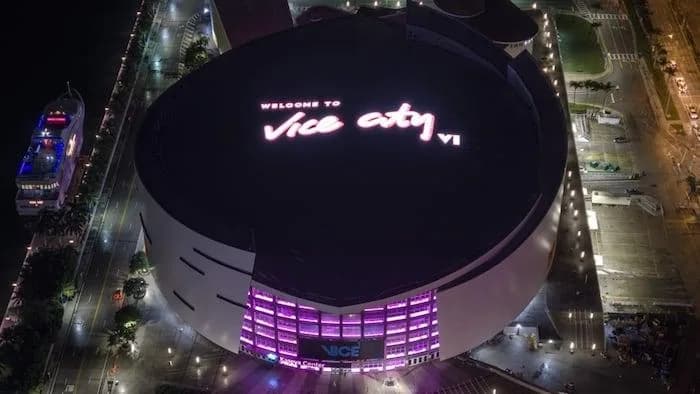
"Welcome to Vice City" on the roof of Kaseya Center, Miami. Image: user-provided photograph; original photographer not verified.
A visitor arriving in Miami could reasonably expect a welcome sign.
"Welcome to Vice City" makes the greeting more complicated.
The words now glow across the roof of the county-owned Kaseya Center. On October 28, 2026, Miami-Dade announced a GTA VI advertising package valued at $3.9 million. The agreement behind the rooftop installation is part of that total, not an additional deal. The county hopes to earn revenue by sharing in the enormous attention surrounding Rockstar's game.[ [Source]](https://www.miamidade.gov/global/release.page?Mduid_release=rel1793224106473569)
It is an extraordinary destination pitch: visit the real place that helped inspire a fictional crime playground.
The beaches are real. The getaway is optional.

Even the manhole covers were on the table
In August, NBC 6 reported that Rockstar had approached Miami-Dade about working together around GTA VI's release. County proposals included Vice City branding on the Metromover, murals on prominent public buildings, and logos on manhole covers. Officials saw an opportunity to draw gamers curious about the real locations behind the fictional city.[ [Source]](https://www.nbcmiami.com/news/local/miami-dade-wants-in-on-hype-around-gta-6-release-heres-what-the-county-is-proposing/3851971/)
The manhole covers are a particularly good detail. Tourism campaigns usually direct your eyes toward a skyline, an ocean view, or a landmark. Here, someone saw promotional potential beneath visitors' feet.
For a fan, that could be a photograph worth taking. For someone walking to work, it could be another surface claimed by advertising. The same city can offer a holiday to one person and an ordinary Tuesday to another.
The proposals also need to be called proposals. An idea for a branded manhole cover is not proof that one has been installed.
What the $3.9 million actually means
The October announcement moved the campaign beyond imaginative suggestions. But the headline figure needs precision.
According to the county, $3.9 million is the stated value of a package comprising an agreement with Rockstar and separate advertising purchases made through companies that manage space at Miami International Airport and along the county transportation system. It is not a single unrestricted $3.9 million payment to county government.[ [Source]](https://www.miamidade.gov/global/release.page?Mduid_release=rel1793224106473569)
The earlier Kaseya Center arrangement accounts for $975,000 of that package. Miami-Dade says those funds have been allocated to developing a public park at Dan Paul Plaza behind the arena. Rockstar covers production and installation costs.[ [Source]](https://www.miamidade.gov/global/release.page?Mduid_release=rel1793224106473569)
Other announced elements include themed lighting at the airport and PortMiami, displays along airport pedestrian walkways, and decorative wraps for selected traffic-signal cabinets. The rooftop sign was already installed when the county made its October 28 announcement; the newly described installations were plans, with designs still subject to county approval.[ [Source]](https://www.miamidade.gov/global/release.page?Mduid_release=rel1793224106473569)
That difference matters. The advertising agreements are concrete; a surge in GTA-inspired tourism revenue is still a possibility rather than a measured result.
The intriguing bargain is that a fictional city might help pay for an actual park. Whether residents feel the trade is worth it is a separate question.
The sheriff sees a different destination campaign
Not every official welcomed the idea. In a September 3 statement, Commissioner Juan Carlos Bermudez and Sheriff Rosie Cordero-Stutz called for the county to reject the use of public resources to promote GTA VI. Bermudez questioned the wisdom of associating the county with a crime-centered fictional setting; the sheriff pointed to the conflict between the game's notorious activities and real police work.[ [Source]](https://www.miamidade.gov/global/release.page?Mduid_release=rel1788447602441436)
Their disagreement cannot be dismissed as simply disliking a video game. A customer chooses to play GTA privately. Placing game branding on publicly owned infrastructure is a collective decision, made on behalf of people who never asked to join the campaign.
There is also a dispute about process. WLRN reported on October 29 that several county commissioners objected to the administration moving forward with the advertising agreements without putting them to a full commission vote. That shifts the question from what the signs say to who gets to authorize them.[ [Source]](https://www.wlrn.org/government-politics/2026-10-29/miami-dade-announces-4-million-gta-vi-marketing-agreement-with-rockstar)
A marketing team, a sheriff, and a neighborhood resident can all understand that Vice City is fiction and still disagree about what official promotion appears to endorse.
A place can be attractive without being flattering
Vice City does not need to depict an admirable society to make its setting desirable. A player may enjoy an outlaw story and still want to visit Miami for its architecture, waterfront, music, or atmosphere. Recognizing a street or skyline can spark curiosity without creating any wish to recreate the crime.
But that also grants the fictional version influence over the real place. Some visitors may arrive with an itinerary shaped by a game rather than a guidebook. An ordinary street may feel familiar before they have ever stood on it.
This is where tourism's promise becomes more complicated. A neighborhood has a life beyond its resemblance to a virtual location, and its residents are under no obligation to perform the fantasy visitors recognize.
What happens when someone comes looking for Vice City and finds a city that refuses to fit neatly inside it?
One name, several governments
Miami-Dade County, the City of Miami, and Miami Beach are separate governments. The county's October release also refers to advertising arrangements made by the two cities, including downtown banners and promotions on beach concession equipment. Those are not the same contracts or decisions as the county package.[ [Source]](https://www.miamidade.gov/global/release.page?Mduid_release=rel1793224106473569)
A photograph of one rooftop does not establish that the entire region has been renamed or transformed. Nor do conceptual designs prove that all proposed installations are in place.
The story is more revealing when those distinctions remain visible: different authorities, different public spaces, and different ideas about how much of a fictional identity should be borrowed.
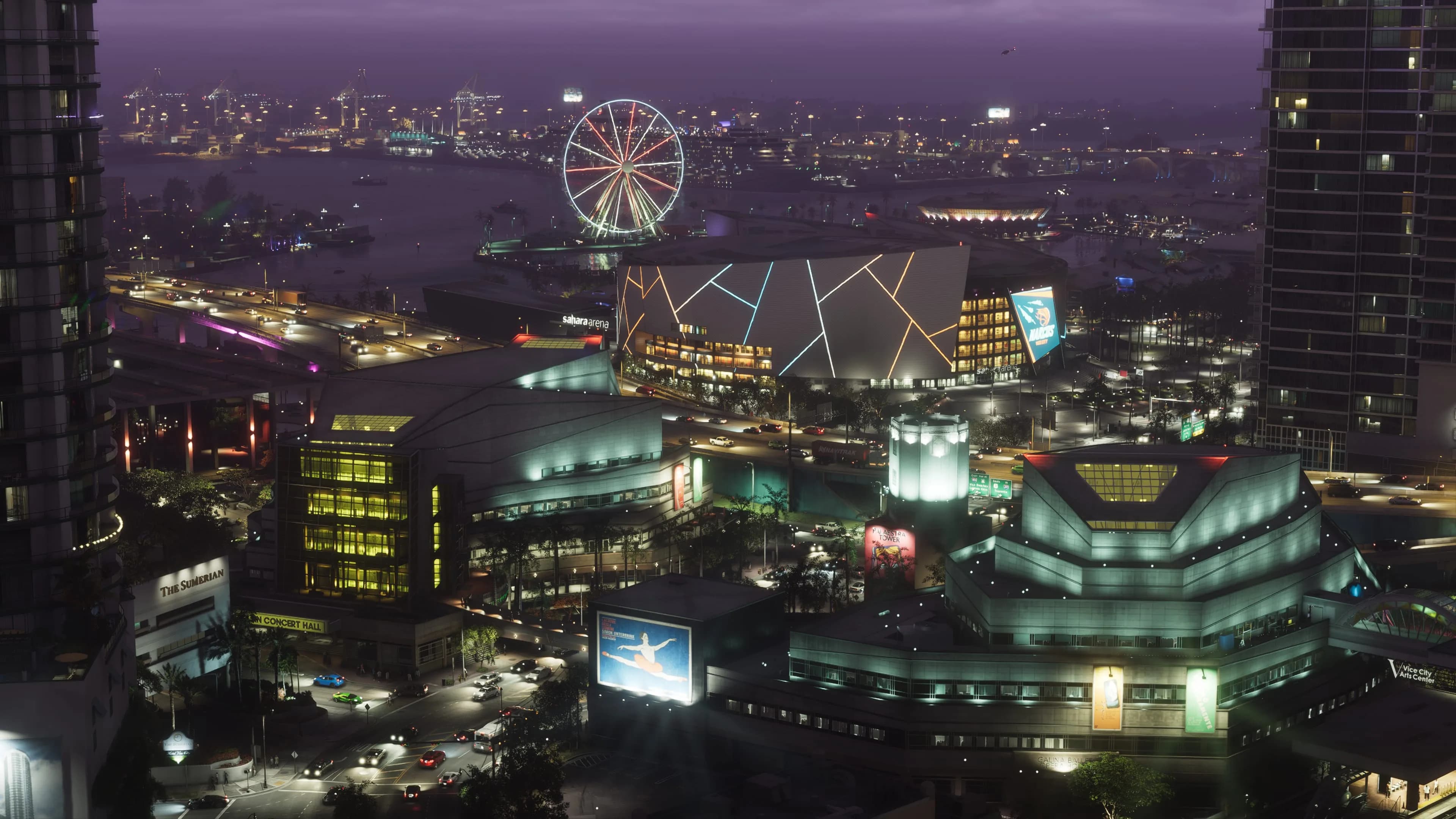
The visitor arrives after the joke
For Rockstar, Miami offers material for an invented world. For public officials, that invented world offers a way to lead attention back to Miami.
Supporters imagine a tourist who books a room, visits a restaurant, and explores the waterfront. Critics see a government lending its property and reputation to a fantasy built partly around crime. Neither side needs to misunderstand the game to reach its conclusion.
The visitor may simply want a photograph.
They look up at the arena, recognize the glowing name, and reach for their phone. Behind "Welcome to Vice City," the real county still has to decide what kind of welcome it is offering.